On Sunday, 22nd June, Pain Research Reading, an interdisciplinary group of pain researchers based at the University of Reading hosted ‘The Puzzle of Pain’. This was a free, full-day event open to the general public that featured: interactive talks by researchers, industry experts, and patient partners, along with hands-on demonstrations and workshops, an art installation, and a live recording of the PAINCAST podcast (embedded below) by PAINSTORM (a research project focusing on neuropathic pain) and hosted by BBC Radio 3’s Fiona Talkington.
Why do we swear when we’re hurt?
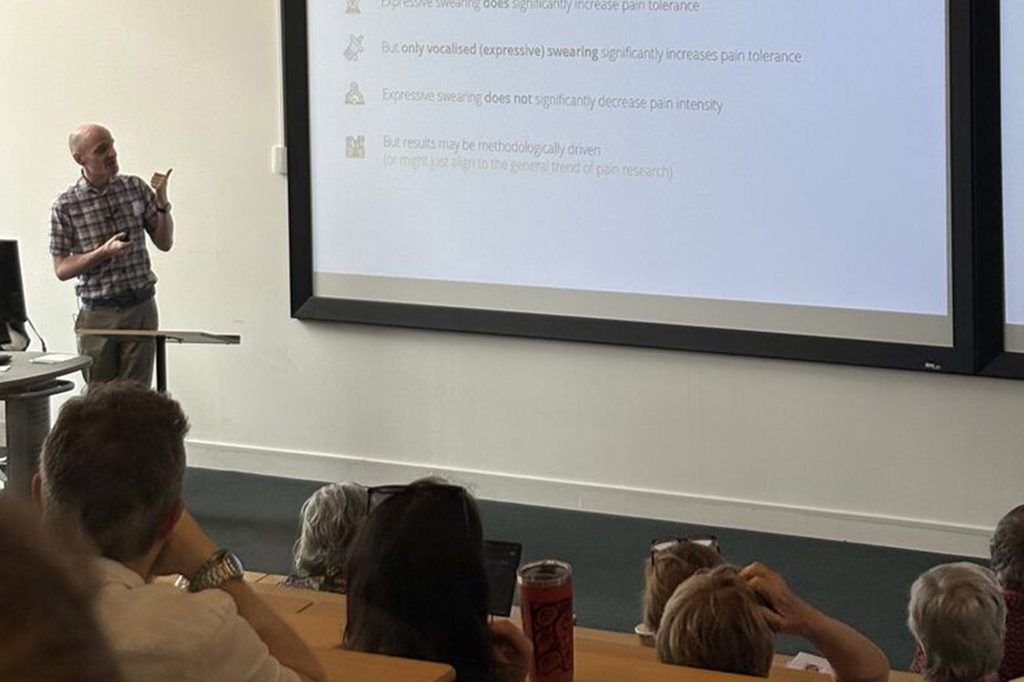
Chris gave the final 10-minute ‘TED-style’ talk of the morning session to a packed lecture theatre discussing his findings from a meta-analysis (a study of studies) he’d conducted into the effect of saying a swear word on both pain tolerance and pain intensity. As the final talk of the morning, Chris’ talk was fresh in the memory of those in attendance and so he had to field lots of questions (from senior academics, members of the public, and clinicians from the Royal Berkshire Hospital) into the research he presented, why he thought swearing helped, and whether he’d considered the affect swearing has on those hearing it rather than those expressing it.
Chris providing the answer as to whether swearing helps pain during the 'Puzzle of Pain' event
Chris explained how, after running a systematic search of databases detailing publish, academic literature for papers including both topics of ‘pain’ and swearing’ he had sat and read through around 13,000 papers, filtering out those which weren’t relevant until he just had left those papers that dealt specifically with the effect of swearing on pain. Once he’d whittled the papers down, he then set about searching for unpublished literature (by contacting academics known to have conducted research into swearing to see if they had any unpublished research they could share). Armed with both the published and unpublished research, Chris could then extract the individual study results to allow him to conduct a secondary analysis of the pooled data to better understand the effect of swearing on pain based upon current knowledge.
The analysis specifically looked at two dimensions of pain: tolerance (how long someone can withstand a painful stimulus) and intensity (how much the painful stimulus hurts). The analysis of the pooled data found that swearing does seem to have a significant effect on pain tolerance, but doesn’t seem to have a significant effect on pain intensity. However, the picture regarding pain intensity isn’t totally clear, as the studies that do report an effect of swearing on pain intensity also report that the effect might depend on a participants’ gender.
The review is currently in the process of being published, keep an eye on the ‘Studies‘ page, as we’ll post a link to the review once it’s out.
Share Article
Content notice
This website discusses the science and psychology of swearing.
As a result, you may encounter words that some people find rude,
offensive, or upsetting.