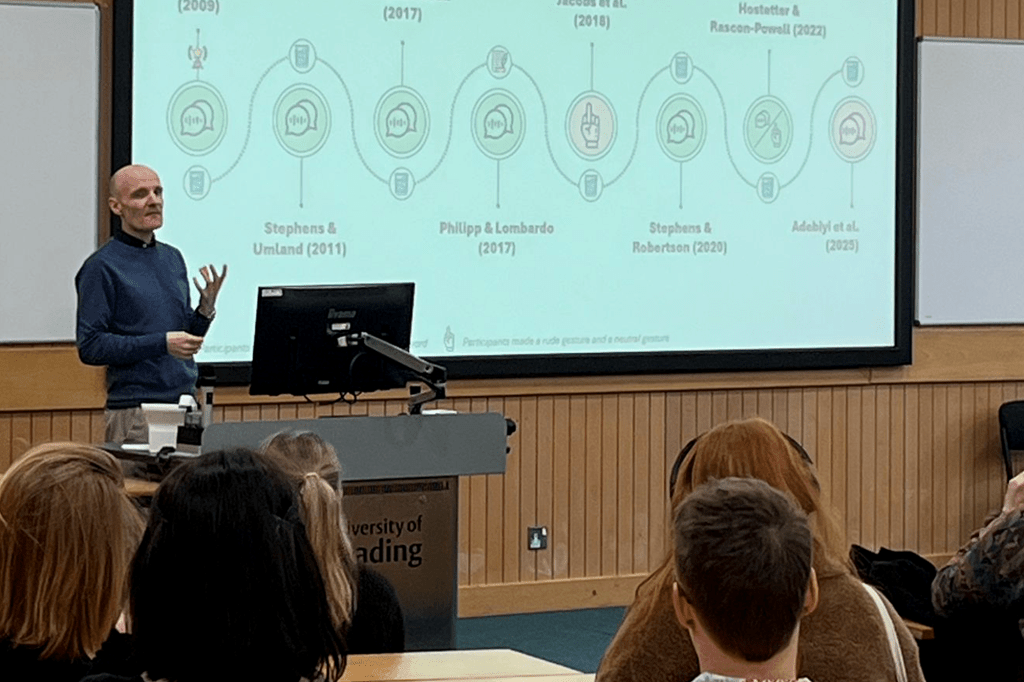
Every year the School of Psychology and Clinical Language Sciences (PCLS) at the University of Reading hosts a PhD student and early career researcher conference, bringing together over 100 researchers from across the entire school to showcase their research in a day of presentation, posters, and networking. The conference usually fall in June, at the height of what is, within academia, often considered the conference season. This year, however, PCLS changed things up and combined the conference with a newly created ‘Next Step Festival’.
There were two reasons for this change. Firstly, the festival was designed to allow the ~800 undergraduates and MSc students with PCLS the opportunity to interact with an entire day of activities designed to help them decide “what comes next”. This meant that talks were put on about future careers, both within academia and further afield, as well as talks about how to get PhD funding, what PhD opportunities were available in the department, and what it was like to be a PhD student in the department. And second, “taught students” as undergraduates and MSc students are called within academia, often go home for the summer. This means that attendance at the PhD conference can be hit and miss. By bringing it forward to during Semester 2, when the “taught students” are still being taught, attendance should be increased. Which is exactly what happened.
Leading the way...
As a third year PhD student, Chris was required to apply for an oral presentation. Applications are short listed with four speakers presenting in the morning and four presenting in the afternoon. Those who apply but are unsuccessful have to present either a poster, or a research blitz (where you are required to boil down a study into just a three minute summary). Chris, however, was one of the eight PhD researchers chosen to give an oral presentation and, in fact, was asked to lead the way in the afternoon session, presenting a 15 minute talk on his study investigating how swear words disrupt time perception.
At the end of last year, Chris concluded a study trying to better understand whether the way we are receptive to swear words in our environment (i.e., seeing them versus hearing them) would make a difference to the effect, shown by Tipples (2010) that suggests receptive swearing can make people think less time has passed than really has. Presenting to a packed Madejski lecture theatre, Chris provided details of the two experiments he ran, initially replicating Tipples’ study, and result, before altering the methodology to test out the robustness of the effect. He then ran the audience through how his results could be tied into a study, currently recruiting participants, that is trying to link the findings around the effect of swearing on time perception to the effect vocalised swearing can have on pain tolerance.
The study is currently being prepared for publication, so keep an eye out on the site for a post about it when it’s been published. The findings are truly fascinating and potentially add another piece to the jigsaw of explaining just why swearing is such a ubiquitous response to pain!
Share Article
Content notice
This website discusses the science and psychology of swearing.
As a result, you may encounter words that some people find rude,
offensive, or upsetting.