

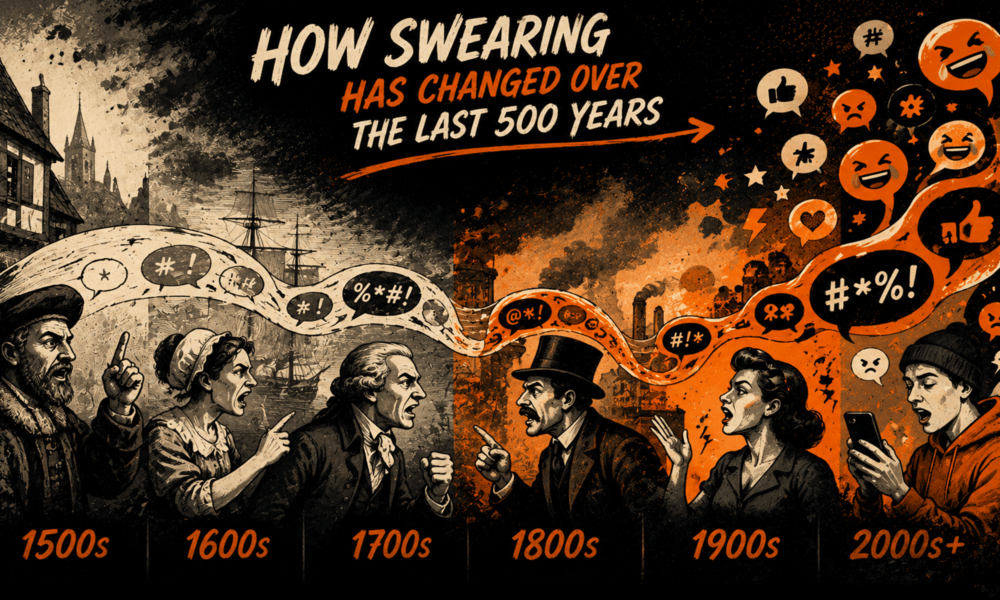

Taboo language is not new. Travel back in time 500 years and you’d still find people using swear words. The difference, however, is that the words people found shocking back then are not the words you’d find shocking today.
The reason is that swear words do not stay offensive forever. Their power depends on what a society treats as sacred, shameful, disgusting, and/or unacceptable. As those values change, the language of offence changes with them (Allan & Burridge, 2006; Jay, 2009).
The history of swear word is, therefore, not just a history of rude words. It is a history of changing beliefs, changing social norms, and changing ideas about what should and should not be said.
Religion was once the greatest taboo
Modern swear words are predominantly clustered around words that describe sex, bodily functions or insults (Allan and Burridge, 2006). But in medieval and early modern England, some of the most offensive forms of swearing were religious.
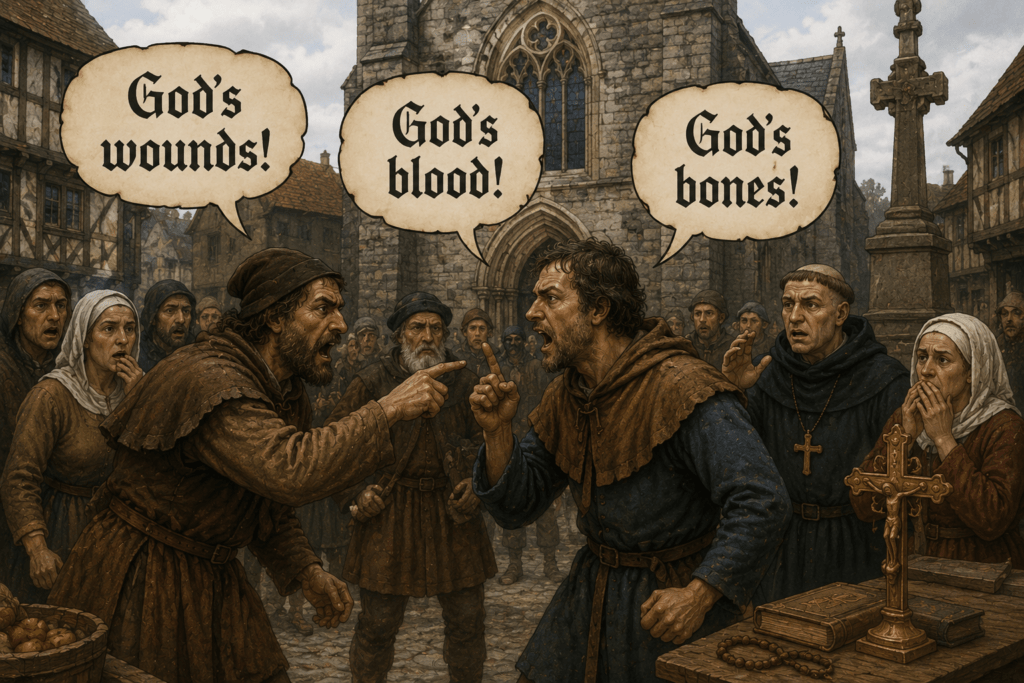
Words that invoked God, Christ, and/or sacred objects were used treated blasphemous. Expressions such as ‘God’s wounds’, ‘God’s blood’, or ‘God’s bones’ were seen as disrespectful to the divine (Hughes, 1991; Hughes, 2006). Medieval society was based around a structure in which religion shaped law, morality and everyday life. As a result, religious language carried enormous emotional weight and so the use of those words negatively was seen as offensive because of the cultural meanings attached to them.
As British society became less governed by shared religious authority, many religious terms gradually lost their force. What had once been shocking became mild, old-fashioned or even quaint. A good example is ‘zounds’, a softened form of ‘God’s wounds’, which now sounds more comic than shocking.
Sex gradually replaced religion
As religious taboos weakened, other words gained a notoriety and powerful. From the 18th and 19th centuries onwards, attitudes towards sex and bodily functions became increasingly taboo (Hughes, 1991; Hughes, 2006). This meant that connected words became increasingly unsuitable for polite conversation, and therefore increasingly available as swear words (Allan and Burridge, 2006).
The reason for this shift was that public life had become shaped by ideals of refinement, particularly among the middle and upper classes. It became improper to openly discuss sex and bodily functions, leading the words associated with them to be more socially charged, and therefore, more useful as swear words.
A good example is the word, ‘piss’. Around the turn of the 17th century, Shakespeare included the word in The Merry Wives of Windsor and Henry VI, Part 2. But as 18th and 19th century ideas of politeness changed, the word gained a notoriety and power that meant it was increasingly unsuitable for uttering as part of respectable speech. The word had not changed, but the social response to it had.
Mass media changed who heard swearing
For most of history, swearing was mainly encountered in face-to-face conversation. Printed books, newspapers and official documents often avoided offensive words, either because of law, convention or expectations about respectability.
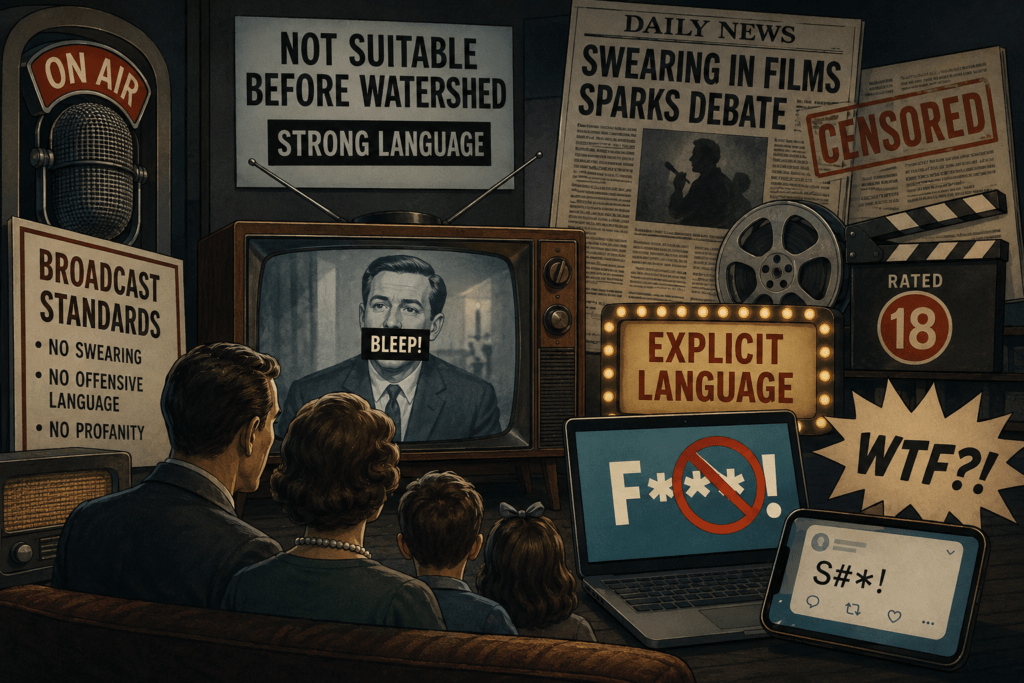
Radio, cinema and television changed this. Suddenly, the question was not only what people said privately, but what could be broadcast into homes, printed in newspapers, or shown in films. Swearing became a public issue. Censorship not only helped shape which words were considered acceptable in different settings but gave a new form of power to those words. A word tolerated in an 18 rated movie would be restricted before the watershed (9pm in the UK), while newspapers would refuse to print offending words, or replaced simply replace some letters asterisks. These decisions did not just reflect public attitudes though, they actively helped create them.
Censoring a swear word, however, can actually make it more noticeable. A bleep, blank space, or string of symbols draws the reader’s attention to the missing word, pointing out to them that there is something they are being protected from (Roache, 2023). Psychologically, this makes sense. Taboo words are emotionally salient: they attract attention, provoke stronger reactions and are often remembered more readily than neutral words (Jay, 2009; Jay, 2020). By the late twentieth century, many words that had once been rarely heard in public media had become more common in films, comedy and everyday broadcasting.
This shift hasn’t meant the end of taboo language, though. Its simply moved the boundaries regarding the types of word we use once again.
The internet changed the shape of swearing
The internet has not only made swearing more visible, but it might also be changing the kinds of swear words use, too. As described, earlier shifts in swearing were about the source of taboo: from religion to sex and bodily functions. In the digital age, another kind of change is happening. Swear words are getting shorter (Love, 2021; Love and Stenström, 2023). We don’t really know why, but it could be because verbal communication is being replaced by written communication (Verheijen, 2015). Shorter words are easier to write making them easier to write in texts, comments, and captions.
In fact, Love and Stenström (2023)’s findings may suggest that people now increasingly use a swear word like ‘fuck’ to emphasise a point or increase the emotionality of their statement, rather than as a literal sexual descriptor or as a term of abusive. The word is changing, potentially reducing how offensive it is, because its function is changing. A swear word that once drew much of its force from sexual taboo is gradually becoming a more general-purpose emotional tool.
This means that the next transition may not be towards one, new, category of societal taboo in the way that sex replaced religion. Instead, swear words may become shorter, more flexible, and easier to move between speech and writing. The next stage in the history of swearing may be less about what words refer to, and more about how efficiently they can carry emotion across changing forms of communication.
The next generation will swear differently
Every generation seems to worry that language is declining. Older speakers often complain that younger people swear too much, while younger speakers may see older taboos as outdated or irrelevant. That matters because it shows that swearing is not a linear transition from polite to offensive, or from offensive to acceptable. It is constantly reorganising around new social norms.
The strongest words in one generation may be mild in the next. New taboos may emerge. Old insults may become unacceptable for reasons that earlier generations did not recognise. Some words may be reclaimed by the groups they once targeted, while others may become more restricted, not less. And trying to predict these shifts is virtually impossible.
Why does this matter?
Discussions around swearing are often dismissed as inappropriate or irrelevant but swearing tells us a great deal about human behaviour. The words people avoid, censor, whisper, laugh at, or punish reveal what a society values and what it finds threatening.
Five hundred years ago, religious oaths could provoke outrage. Two hundred years ago, sexual and bodily language became more powerful. And recently, mass media turned swearing into a public debate. The internet and a transition to a ‘digital’ world created a new freedom to use taboo language but also changed the type of words people use.
Swearing evolves because societies evolve. That is why the history of swearing is not just a history of offensive language. It is a history of emotion, identity, morality and social change.