

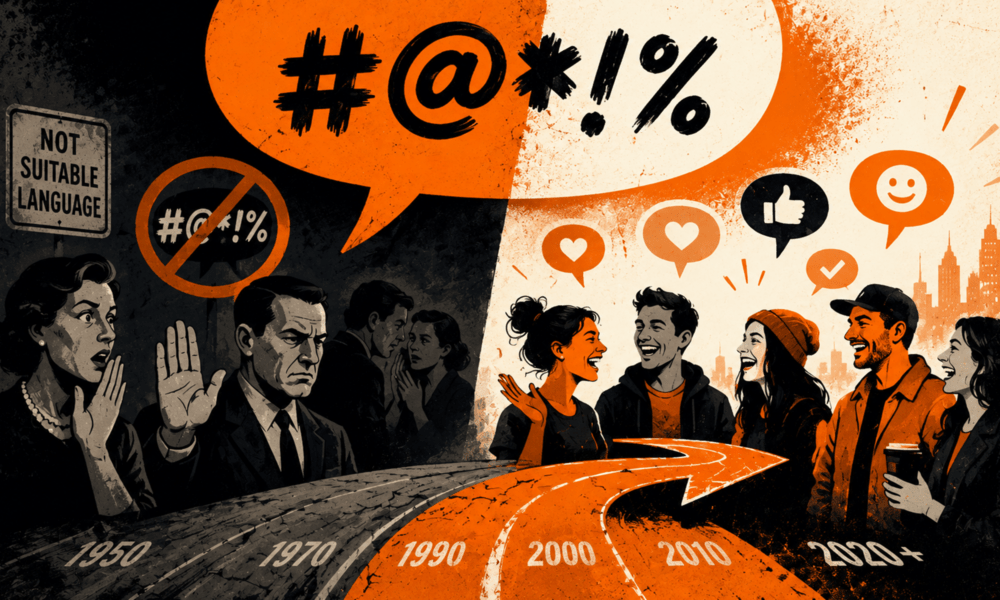

It certainly feels at times as though swearing is everywhere. From its uncensored use in podcasts, social media posts, and streaming television, to political outbursts and viral advertising campaigns, words that would have been once carefully edited out of public life are fast becoming just a normal part of it. It’s very easy, therefore, to declare that swearing has become more acceptable. But the truth is slightly messier.
The problem is that ‘increased swearing’ and ‘increased acceptable swearing’ are not the same thing. A swear word can become more visible without becoming universally approved of. Equally, a swear word can become less shocking in some contexts, while remaining completely inappropriate in others.
This is why context matters so much. Swearing among close friends, in a comedy routine, or during an emotionally charged story is not judged in the same way as swearing at a colleague, a stranger, or a child. Research has long argued that the appropriateness of a swear word is strongly shaped by context, including who is speaking, who is listening, and what the speaker is trying to achieve (Jay & Janschewitz, 2008; Jay, 2009).

If context does so much work in shaping how swearing is judged, it is worth taking a moment to consider whether the apparent increase in swearing is driven by a relaxation of general societal contexts or an actual increase in the frequency of swear words being said. In other words, do we say more swear words, or are we just spending longer in situations where we already swear?
The evidence on frequency turns out to be more complicated than it might first appear. In a study comparing informal spoken British English from the 1990s and the 2010s, researchers did not find evidence to support an increase in swearing within everyday conversation. In fact, their data suggested that, overall, swearing was actually decreasing (Love, 2021). This does not mean that swearing is disappearing as a part of language, though. Rather, it was tied more to the way people swear and the way statistics work. While the use of many swear words is decreasing, a few others have become far more common. This means that, when averaged as a category, usage seems to decrease, even though our exposure to a few individual words has increased. Leading to the sense of an apparent explosion of swearing in day-to-day life not supported by the data.
This is why it is not especially useful to ask whether people swear “more” than they used to. It’s better to instead focus on how people are actually using swear words. Work by Love & Stenström (2023) on British teenage speech found that the word ‘fuck’ was rarely used literally, or even as an insult. Instead, teenagers frequently used it to add emphasis, humour, emotion, or social meaning to what they were saying. In other words, they had shifted the word from being purely a shocking or offensive term, creating something far more flexible: a way of making speech sound stronger, funnier, more intense, or even more authentic. And it’s worth remembering: a swear word used to make a story funnier is doing something quite different from a swear word used to insult or intimidate someone.
Research into the use of swear words on in the media appears to follow a similar pattern. Ofcom’s research on offensive language on television and radio suggests that audiences base their opinion on the acceptability of swearing from the context in which it appears. Audiences find swearing fair more acceptable after the watershed, when it fits the programme, and/or when the words are used for emphasis rather than for aggression (Ofcom, 2021).
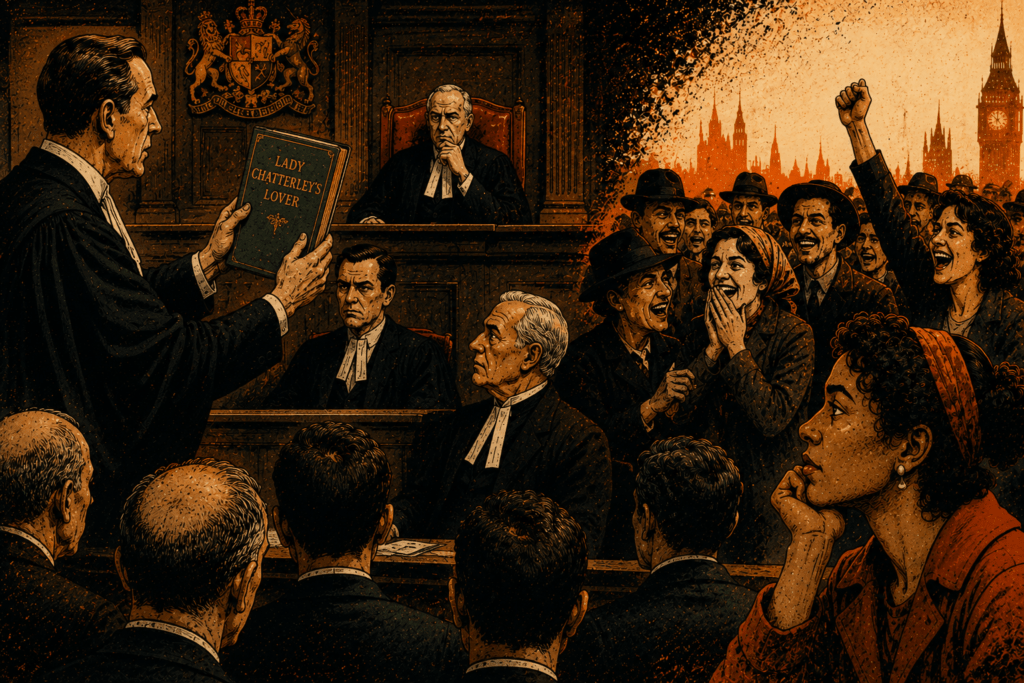
Written culture offers a similar story. For example, for many decades English dictionaries omitted the most taboo words rather than defining them. The word ‘fuck’, in use since at least the sixteenth century, was only included in the Oxford English Dictionary in 1972 (Mohr, 2013). The turning point that lead to its inclusion was, surprisingly, legal rather than societal. In 1960, the publishers of D. H. Lawrence’s Lady Chatterley’s Lover were taken to court in Britain on obscenity charges. The publisher’s won (as they argued the book had a literary merit above and beyond any obscene language it contained) paving the way for other publishers and lexicographers to gradually become more willing to print words that had previously been treated as unprintable (Mohr, 2013).
This trend continues into more recent history. Research, analysing tens of thousands of American books published between 1950 and 2008, examined the frequency of seven words identified by the comedian George Carlin in 1972 as “the seven words you can never say on television” (Twenge, VanLandingham, and Campbell, 2017; for the seven words, click here). It was found that books published in the mid-2000s were around 28 times more likely to contain these words than books from the early 1950s. While this does not indicate universal approval of swearing, the research fails to take into account the context of the words’ usage, it does highlight a sustained shift among publishers, authors, and readers towards greater tolerance of taboo language.
Is swearing becoming more acceptable?
The answer appears to be yes, though only if we are careful about what we mean by it. Swearing seems to be more visible in public life, more common in some media, and more likely to be used for emphasis, humour, authenticity, and social bonding. But its acceptability remains, however, deeply dependent on context. The same word can make someone sound honest among friends or careless in the workplace, funny on stage or cruel in an argument.
Swearing has not stopped being taboo but it has become more flexible. We use a few choice words more than we ever have, but we use them in specific social settings. it’s becoming more socially complicated.