Now in its 15th year, the Reading Emotions symposium is an annual, two-day inter-disciplinary affective neuroscience conference hosted at the University of Reading. This year, the conference was organised by Pain Research Reading, bringing together pain researchers from universities around the world to discuss the latest research into pain (covering everything from clinical research applications and ‘big data’ neuroscientific projects, to mechanistic intervention studies and the role of including participant groups when designing study methodologies.
This year, Chris was one of a handful of PhD students and early career researchers given the opportunity to present a poster at the conference. The posters were displayed in the the same room as lunch was served, ensuring a really good turnout of people to talk to across both days.
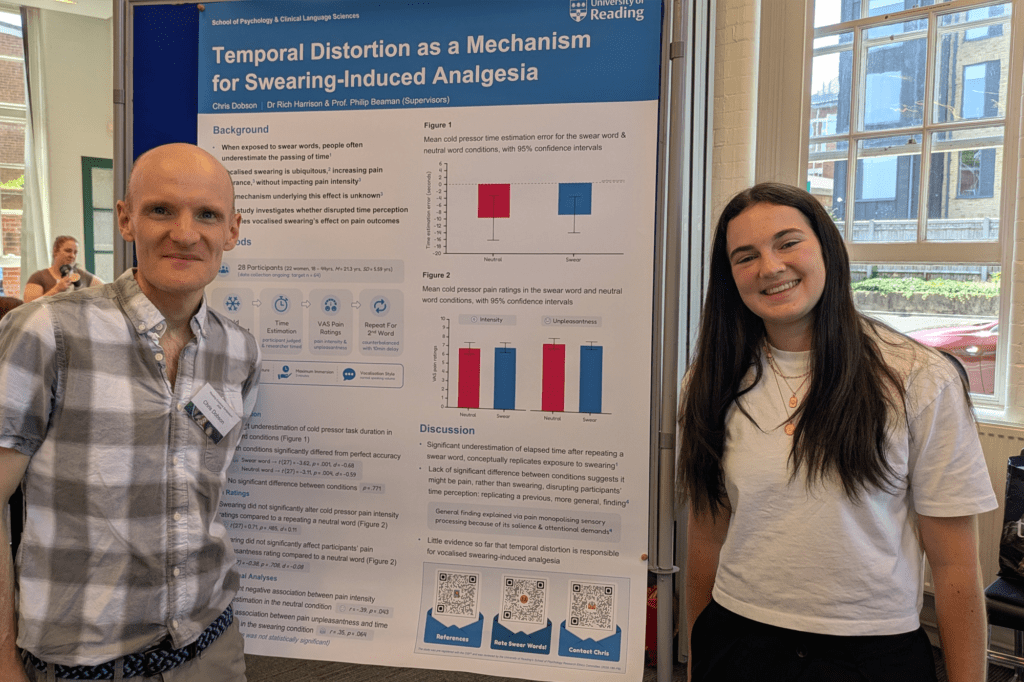
Chris with Evie Price who has been helping collect data as part of her MSc placement
Chris took the opportunity to display a ‘work in progress’ poster, reporting the current results of a study that is roughly half-way through data collection. The study investigates whether the ability of swear words to disrupt someone’s time perception may play a role in their ability to also help people tolerate more pain.The poster proved a real hit, with Chris fielding questions for so long that lunch on the first day became the last of the fruit salad as the rest of the offerings were long gone!
Reading Emotions also gives those in attendance the chance to test out their ability to tolerate experimentally induced acute pain (or to put it another way, the equipment from the Pain Lab within the Centre for Integrative Neuroscience and Neurodynamics is set up and people given the chance to try it out. Evie Price, who has been helping with data collection for the study was tasked with running one piece of equipment (the cold pressor machine as it’s used in the study so Evie is trained to operate it) and so Chris and Evie took the chance for a photo by the poster.
The study is still ongoing if you’d like to take part, click here.
Share Article
Content notice
This website discusses the science and psychology of swearing.
As a result, you may encounter words that some people find rude,
offensive, or upsetting.