

Studies
Information about past and present studies
1. Examining how eye-contact alters the behavioural effects of swearing
Research has found that swearing can increase risk-taking, but the effect has proved unreliable in unsupervised online settings. Online disinhibition, where reduced social cues weaken the emotional impact of swearing, potentially underlies this unreliability. Enforced eye-contact during social situations can overcome online disinhibition, though. As a result, enforced eye-contact, via video calling software, had been used to restore the effect of swearing on risk-taking during online testing. This study replicated that finding, before extending it to test whether swearing, while making eye-contact with a pre-recorded video of a researcher, could also counteract online disinhibition to restore the effect, with results finding that it could.
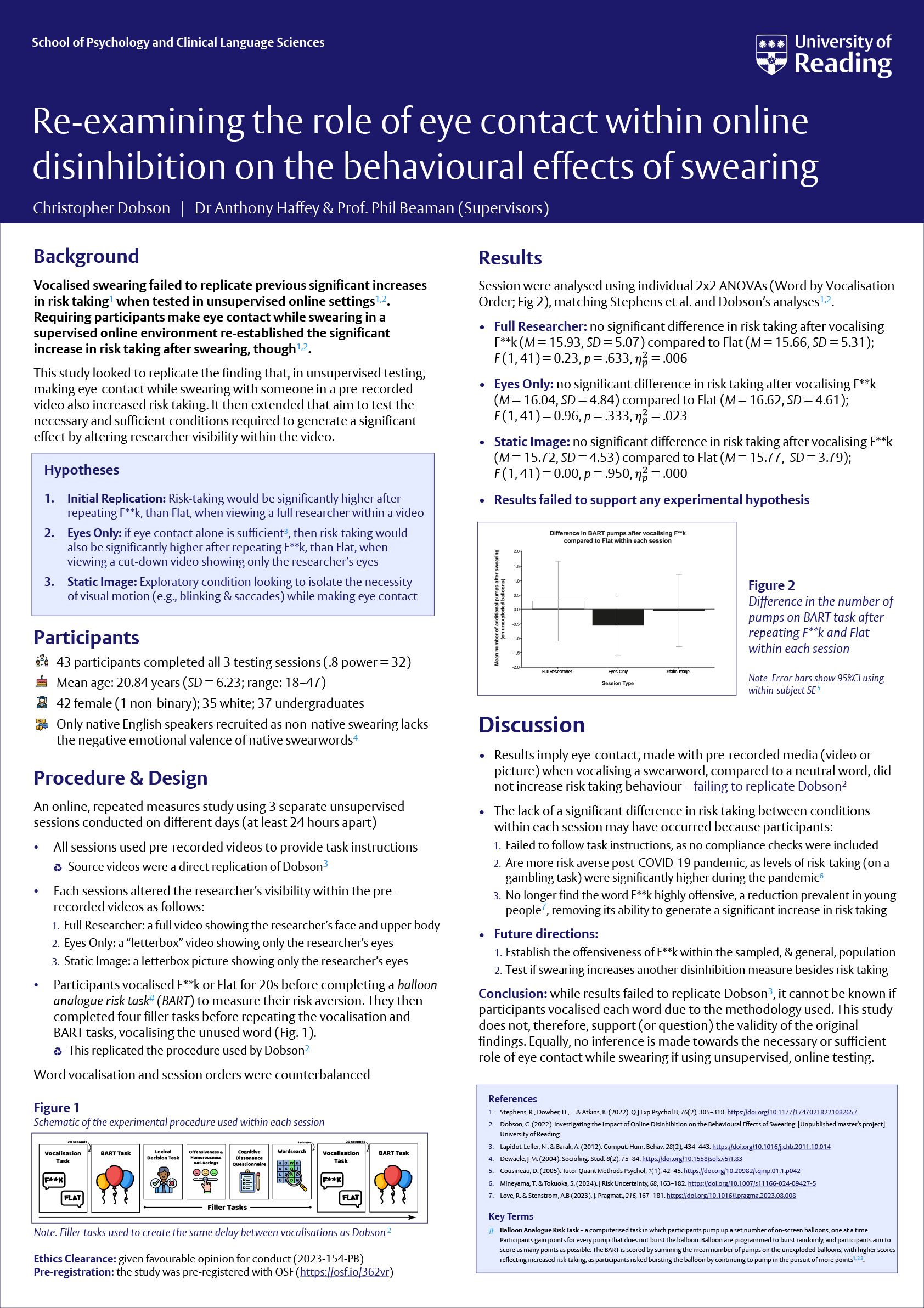
2. Re-examining the role of eye contact on the behavioural effects of swearing
Having found that enforced eye-contact with a pre-recorded video of a researcher was capable of overcoming online disinhibition to restore the effect that swearing caused increased risk-taking (study 1 above), this study looked to replicate and extend that finding. Specifically, this study tested how much of the researcher needed to be visible in the video for any online disinhibition generated by the unsupervised setting to be counteracted. One video showed the researcher’s full face (direly replicating study 1), one was cut down to just their eyes, and one just showing a static image of their eyes that (to allow the role of eye movements in overcoming online disinhibition to be ascertained.)
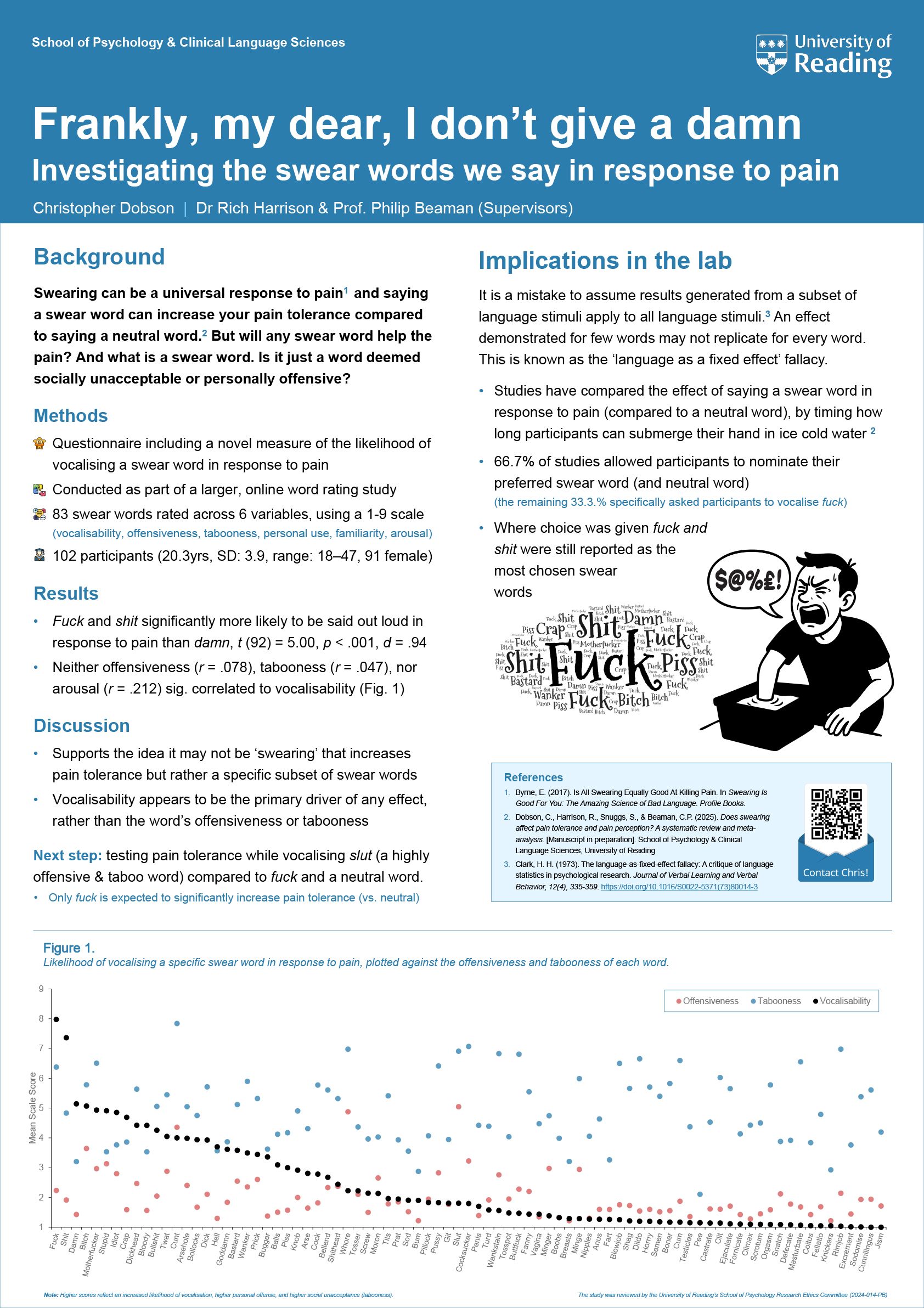
3. Investigating the words we say in response to pain
It has been found that swearing increases pain tolerance. As part of our ongoing word rating study, we have been collecting data specially about the likelihood someone would say a specific swear word in response to pain. This allows us to explore whether all swear words are as likely to be said in response to pain or if people primarily focus on a specific subset. If it is just a subset there is a risk of over-stating the power of “swearing” in helping people cope with pain. We have also looked at whether there is a relationship between the likelihood someone would say a word in response to pain and the offensiveness and tabooness of the word. In other words, does the choice of swear word someone uses relate to the inherent ‘swearwordiness’ of the word.
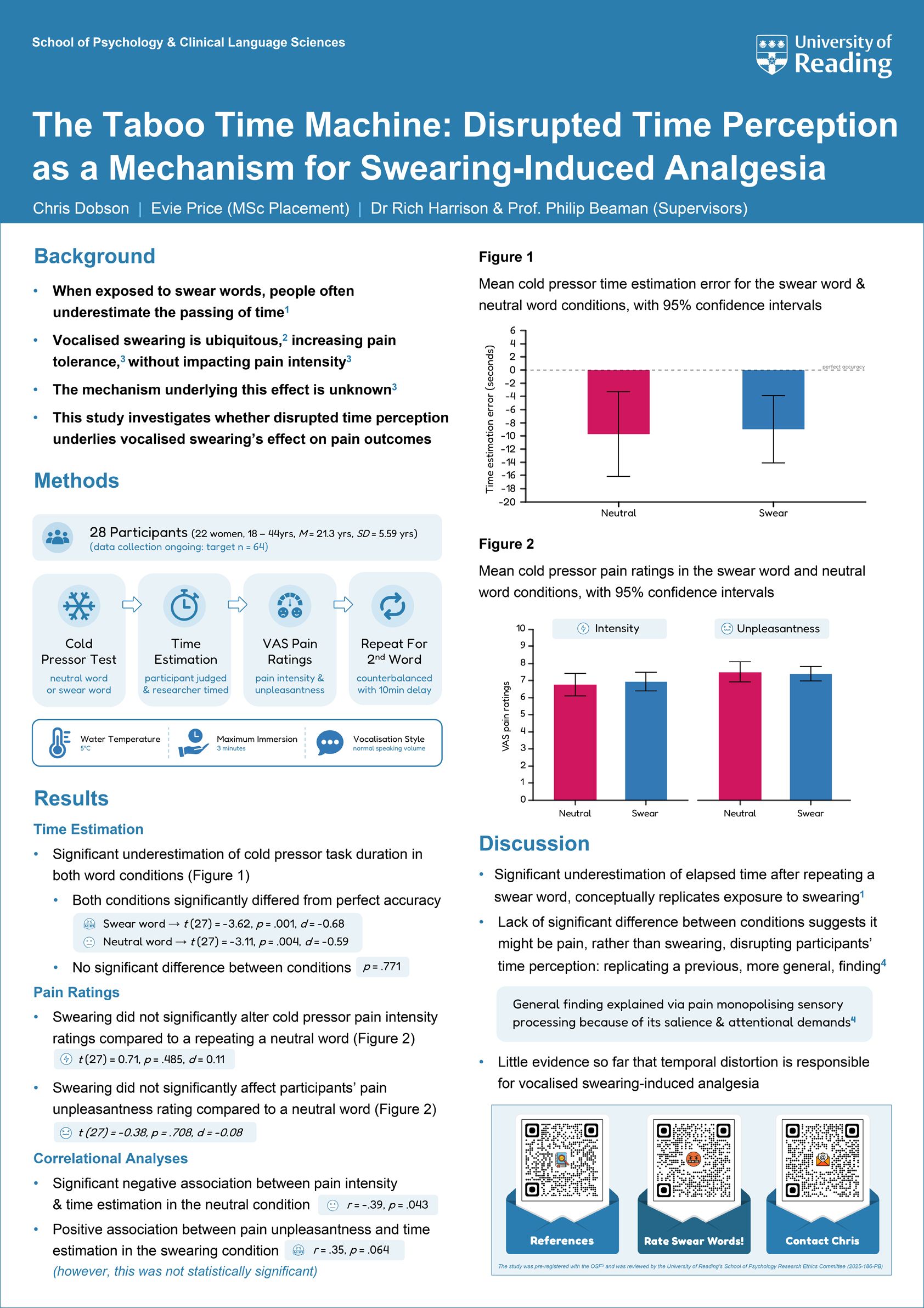
4. Disrupted Time Perception as a Mechanism for Swearing-Induced Analgesia
The lab is currently running a study looking to test the link between swearing and the three dimensions of pain: tolerance, intensity, and unpleasantness. Specifically, we are looking to test a link between the expected effects of swearing on pain outcomes and a disruption to people’s ability to monitor the passing of time. The study is about half way through data collection (click here for more information about how you can take part) and while it’s hard to draw conclusion from the data yet, Chris presented a ‘work in progress’ of the study at both the Reading Emotions conference and the Wessex Health Partners Interdisciplinary Pain poster session held at the University of Southampton.
Check back often as we'll update this page with details of the studies we run
Did you know...?
In 1939, David O. Selznick, the produce of Gone with the Wind, was fined $5,000 dollars for including “damn” in Rhett Butler’s line: “Frankly, my dear, I don’t give a damn”. This is the equivalent of $100,000 today!